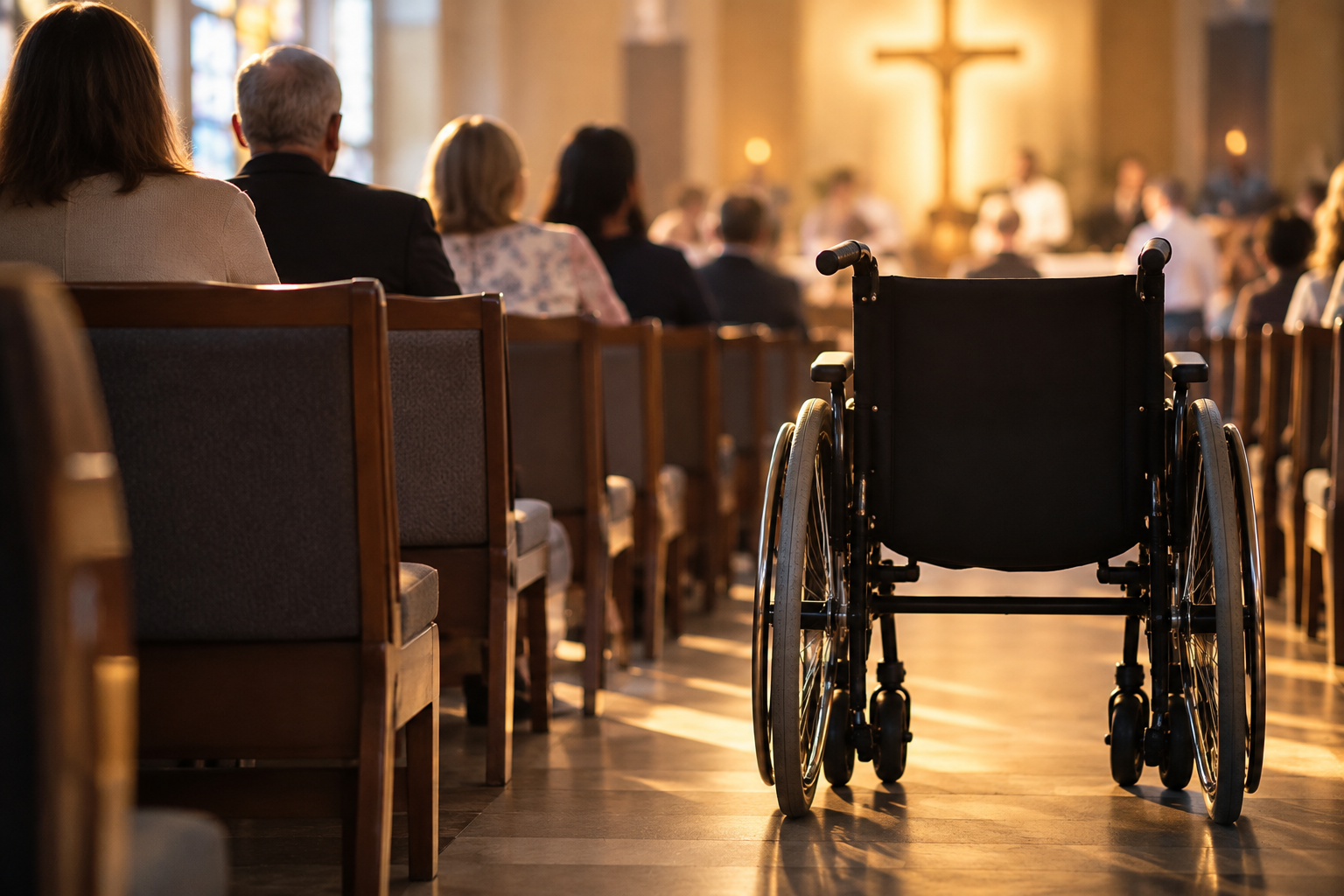
“The eye cannot say to the hand, ‘I don’t need you!’ Or again the head can’t say to the feet, ‘I don’t need you!’ On the contrary, those parts of the body that are weaker are indispensable.” 1 Corinthians 12:21–22
Over the years, I've seen how easily disability ministry can be pushed into the background. A church may genuinely want to welcome families affected by disability. It may even want its disability ministry to grow. Yet sometimes we're hesitant to talk about it, recruit volunteers for it, or give it the same visibility as other ministries.
And there is a contradiction there that I think we need to be willing to talk about.
We can’t say we want families affected by disability to come and then be unwilling to talk about what they need.
We can’t say we want disability ministry to grow while being reluctant to ask people to serve.
And we shouldn’t treat disability ministry as something that needs to stay quietly in the background.
These families aren’t a side ministry. They’re part of the Church.
Who Are We Trying to Reach?
Most churches will tell you their mission is to love people and reach them for Christ.
But here’s the thing: the people Christ calls us to love and reach don’t all look alike, act alike, communicate alike, or come through our doors with the same needs.
People don’t fit one mold.
People come from different backgrounds and cultures.
People come carrying hurt, struggles, and complicated stories.
Some have plenty financially; others are struggling to get by.
Some live with mental illness.
Some have disabilities.
My list could go on, but I think you get the point.
If our mission is to reach people for Christ, we have to be prepared to welcome the people He sends through our doors—not just the people who are easiest for us to serve.
And that makes me wonder about something.
What do our churches really care about?
I remember a father who came to a church where I served with his young son, who had autism.
It quickly became apparent that our regular kids’ program wasn’t going to work for this little boy. The rooms were crowded, the noise was overwhelming, and when he became overwhelmed, he would run.
And boy, could he run!
We needed to find another way to care for him.
There was a classroom that wasn’t being used, so I began looking for volunteers who would be willing to spend the hour with him in a quieter environment.
I found five volunteers who wanted to help make it possible for this dad to attend church.
These volunteers didn’t just agree to watch his son. They grew to love this little boy. They cared about him, and they prayed for him.
They understood that by caring for this child, they were also caring for his father.
This dad only had his son on weekends, and he wanted to be able to attend church. But if we couldn’t provide a safe place for his little boy, he wouldn’t be able to go.
There was just one problem.
Using that classroom as a quiet room wasn’t something the church normally allowed, but I kept thinking about this dad. He needed to be in church. He needed the opportunity to worship and hear God’s Word. And if we couldn’t care for his son, he wouldn’t be able to attend.
For him, we were his opportunity to be part of a church.
Eventually, I was told that we couldn’t continue with this arrangement.
Something about that just didn’t sit right with me.
So I decided to talk with one of our pastors. I explained the situation and asked him how I was supposed to tell this father that we could no longer accommodate his son.
His answer was simple.
“You don’t.”
He explained that as long as we had volunteers willing to care for the little boy in a safe environment, his dad should be able to attend church.
And that was more important than the usual way of doing things.
I’ve never forgotten that conversation.
That pastor understood something I wish more churches would consider. Sometimes welcoming a family means being willing to do things differently. It may mean adjusting a policy, finding another space, or asking volunteers to serve in a way they hadn’t before.
We didn’t need an elaborate program for that little boy. We needed a safe, quieter place, volunteers willing to care for him, and a pastor who understood why it mattered.
What we make room for shows what we value.
What do we spend money on? What do we promote? What gets talked about from the stage? What ministries do we recruit for? What gets our time and attention?
Buildings matter. Events can be wonderful. Good communication and even branding can have a purpose.
But have we become so focused on doing church well that sometimes we forget who the Church is for?
The broken.
The hurting.
The overlooked.
The weak.
The strong.
All of us.
My heart isn’t to point a finger at a particular church. It’s to ask all of us, myself included, to stop and consider:
Are we focused on what God wants us focused on?
Are we open to where He might be leading us?
And are there people right in front of us whom we’ve failed to see?
Indispensable
This verse has been challenging me:
“On the contrary, those parts of the body that seem to be weaker are indispensable.” — 1 Corinthians 12:22 (NIV)
Indispensable.
I keep coming back to that word because it doesn’t mean optional and it doesn’t mean we’ll have a disability ministry as long as it doesn’t require too much from finances and the rest of the church.
Paul says indispensable.
Yet sometimes I wonder if the Church has unintentionally treated people with disabilities and their families as though they are standing on the outside of the Body looking in.
I’ve heard too many stories of families who have been asked to leave a church because the church didn’t know how to support their child. Instead of taking the time to understand the child, learn what they need, and find ways to care for them, the family was told they could no longer come.
That should trouble us. We shouldn’t be comfortable with this.
And exclusion doesn’t always look that obvious.
We may provide a room for them.
We may have a program for them.
We may even call ourselves a disability-friendly church.
But do we know their names?
Do we talk about disability from the stage?
Do we invite people to serve alongside them?
Do we celebrate what they bring to our church?
Do we notice when a family hasn’t been there for three weeks?
And here’s an uncomfortable question: When they aren’t there, do we miss them, or are we sometimes relieved because caring for them requires more from us?
Do we see individuals with disabilities primarily as people we minister to, or do we recognize that they are part of us?
Because there is a difference.
Disability ministry isn’t just something the Church does for people with disabilities. People with disabilities are part of the Church.
And if Scripture says that the parts of the Body that seem weaker are indispensable, then perhaps we need to ask ourselves whether our churches reflect that truth.
Look at Jesus
When I’m unsure what this should look like, I want to look at Jesus. He noticed people others overlooked. He stopped for them. He asked questions and He listened. He saw the person when others saw sin and the condition.
He treated people with dignity and compassion. And yes, many times He healed them. But before we rush to the healing, I don’t want us to miss something important:
Jesus saw and loved the person and He acknowledged them and helped them.
What would happen if our churches became known for doing the same?
What if someone with a disability walked through our doors and people knew their name?
What if we greeted them even when we knew we might not receive a spoken response?
What if we took the time to learn how they communicate?
What if we trained someone to sit beside them so their parents could worship, hear God’s Word, serve, or simply breathe for an hour knowing their child was safe and cared for?
What if we listened when families told us what they needed instead of assuming we already knew?
If We Really Want It to Grow
If we truly want to grow as a church, we need to recognize that God wants His Church to be a reflection of His love. That means being willing to step outside our comfort zones, get involved in people’s lives, and yes, sometimes things might get a little messy.
But that’s where something beautiful can happen.
When a church truly welcomes individuals with disabilities and their families, it doesn’t just bless those families. It blesses the entire church. Relationships are formed, lives are changed, and we begin to see just how much we need one another.
So, churches, if we really want to love people and reach them for Christ, we need to be willing to make some changes.
We need to talk about disability. Tell our congregations why disability ministry matters. Talk about it from the pulpit. Teach people how to welcome and interact with individuals with disabilities and their families. And if we don’t know how to do that ourselves, invite someone who does.
We need to invite people to serve. Don’t be afraid to ask! You might be surprised how many people in your congregation don’t even know your disability ministry exists because they rarely hear about it. We can’t expect people to get involved in something they don’t know about.
We need to equip our volunteers. When someone says yes to serving, we need to train them. Give them the knowledge, encouragement, and practical tools they need to serve with confidence and compassion.
We need to get to know our families. Take time to listen to parents and caregivers. Learn about their children, their strengths, their needs, and what helps them feel safe and comfortable. Build relationships with the entire family.
We need to be willing to make changes. Individuals with disabilities aren’t all the same. What works for one person may not work for another. When something isn’t working, don’t give up on the individual or the family. Be willing to find another way.
And through all of this, we need to pray. Prayer isn’t an afterthought in disability ministry. We need God’s wisdom, patience, compassion, and guidance as we learn to love and serve one another.
Finally, we need to stop treating disability ministry as something that belongs quietly in the background. We need to bring it into the life of the church, where individuals with disabilities and their families are seen, valued, and included.
These aren’t people standing outside the Body of Christ, hoping we’ll make room for them.
They are members of the Body of Christ.
And Scripture calls them indispensable.
We say everyone matters to Jesus.
Maybe it’s time to ask whether the way we do church shows them—and everyone watching—that they matter to us, too.
Comments
I'd love to hear your reflections. Comments are reviewed before they appear. Your email address will not be displayed publicly.