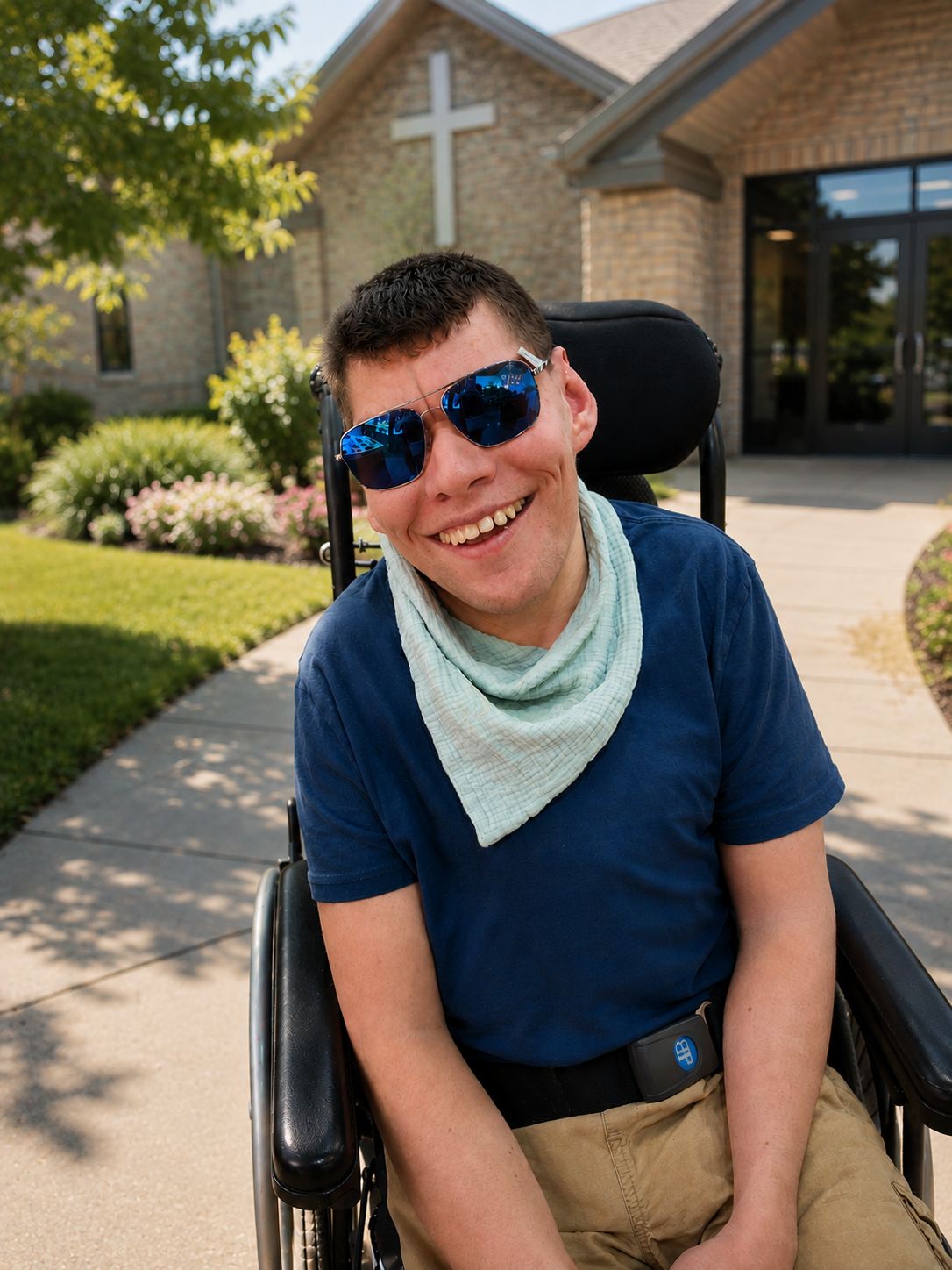
“Accept one another, then, just as Christ accepted you, in order to bring praise to God.” Romans 15:7 (NIV)
Imagine walking into a church for the first time and wondering—not whether you'll be welcomed, but whether your child will be.
Will they understand him?
What if she becomes overwhelmed?
What if he makes noises during the service?
What if they call me out of church again?
Will people stare?
Will they ask us not to come back?
For many families affected by disability, walking through the doors of a church can take courage.
I know, because I’ve been that parent.
When a parent receives a diagnosis for their child, their world changes. There can be so many emotions to work through—and, for many parents, grief. If they’re anything like me, much of that grief comes from suddenly facing a future filled with unknowns.
The day our son was finally diagnosed was the beginning of a journey we never expected.
I still remember how our doctor gave us the news. He delivered it with such grace.
“Basically, David is one of a kind. There is no one else made like him.”
He explained that David had a rare chromosome disorder—so rare that there really wasn’t anyone else to compare him to. He told us that David shouldn’t even be here.
He is a miracle.
Those words brought comfort in the middle of something frightening. Our doctor didn’t deliver the diagnosis with negativity or hopelessness. He delivered it with grace.
The next few months went by so quickly. Before I knew it, our life no longer felt like our own.
Social workers came to our home to help us figure out what we needed to care for a child with special needs. There were specialists and therapists, appointments and evaluations, medical forms and paperwork. There was always something else that needed to be done.
But what no one could see was what was happening inside of me.
I kept it together when I needed to. Then, when I finally had time alone, I fell apart.
Forget the housecleaning. I needed time with the Lord.
Sometimes I would just sit and cry. I needed to understand what was happening. I wanted to know why. I also went to counseling for about six months, and that time helped me process what I was experiencing and become more aware of how God was speaking to me.
Slowly, my perspective began to change.
Instead of seeing David’s disability only through the “gloom and doom” the world seemed to place around it, I began to see the blessing David was—and still is—to my husband and me and to our entire family.
But getting there wasn’t easy.
There were times when I felt as though no one understood the pain I was carrying—or took the time to really know.
My world was completely out of my control. I couldn’t change the situation. I couldn’t fix it. And looking back, I can see that this was exactly where God met me: with my hands open and my eyes, ears, and heart turned toward Him.
What I Wish Churches Understood
This is an area where I believe churches can do better.
When a child comes into a church environment and struggles, we may see an out-of-control child instead of a child overwhelmed by noise, lights, crowds, transitions, or other sensory input.
We may not see the exhausted parents who were awake much of the night because their child couldn’t sleep.
We may not understand why a parent seems frustrated when we approach them about their child. Maybe they have spent years hearing everything their child has done wrong.
Maybe they’ve watched people stare.
Maybe they’ve felt judged.
Maybe another church has even asked them to leave.
By the time that family walks through your church doors, they may be carrying far more than you realize.
And your church has an opportunity to show them something different.
I believe churches of every size can take steps toward welcoming and supporting individuals and families affected by disability. You don’t need a large budget, a special room, or a fully developed disability ministry to begin.
You simply need to be willing to start.
Maybe you’re reading this and thinking, but we don’t have anyone trained for this. What if we do something wrong? What if we don’t know how to meet a child’s needs?
You don’t have to know everything about disabilities before you welcome a family affected by disability. You can start by getting to know the child and listening to the people who know that child best—their parents or guardians.
Ask questions. Be willing to learn. And don’t be afraid to start small.
Here are a few simple ways your church can begin.
Start Before They Walk Through the Door
One of the first things a church can do is make it clear on its website that children with disabilities are welcome.
Under the children’s ministry section, consider adding a Special Needs or Disability Ministry button. Give parents a way to contact you or complete a questionnaire before their first visit.
That questionnaire can ask important questions about their child, such as:
- Diagnosis, disability, or medical needs
- Allergies
- Seizure disorders
- Communication needs
- Sensory sensitivities
- Safety concerns
- What helps when the child becomes overwhelmed
- Anything else the family would like you to know
Think about what that communicates to a parent who is looking for a church where their child will be welcomed, understood, and cared for—and where their family can truly feel like they belong.
Before they have even walked through your doors, you are communicating something important:
We want to welcome your family, get to know your child, and help you feel at home in our church.
Train Buddies
Another step is training volunteers to serve as Buddies—someone who can come alongside a child or individual who may need additional support during church.
You don’t have to know everything about every disability to be a good Buddy. Volunteers can learn to observe, listen, recognize signs of overwhelm, communicate with families, and meet an individual where they are.
(If your church needs help getting started, I've created a free Buddy Training Manual available in the Resources section.)
Welcome the Whole Family
Disability ministry isn’t only about supporting the individual with a disability. It’s also about caring for the family.
If your church has several families affected by disability, consider starting a small group for moms or dads. A traditional couples’ group may not always work for these families. Childcare can be difficult to find, their child may need to follow a specific routine so one parent may need to stay home.
Sometimes ministry means being willing to do things a little differently.
Most importantly, take time to hear their story.
Ask questions.
And then listen.
You don’t need to have all the answers. You don’t need to fix their situation.
Sometimes simply having someone willing to sit with you, hear your story, and care enough to understand can bring more healing than we realize.
For a family affected by disability, that simple act may also be the beginning of knowing:
We belong here.
Sometimes Churches Just Need to Know How
I want to end with this story because I truly believe most churches want to welcome families affected by disability. Sometimes they simply don’t know how.
When David was about four years old, the Lord was leading us out of our little church and into a larger one.
I had started attending a women’s Bible study at the new church. One morning, I went to pick up David and my other son, Tim, who was about two at the time. I had them in this double side-by-side umbrella stroller, and as I was getting ready to leave, the pastor came over and introduced himself.
He looked at David and said, “Hi.”
It was such a simple thing, but I remembered it.
And he kept doing it.
Whenever we came to church, our pastor would come over and say hi to David and shake his hand. He didn’t ignore him or just talk to us. He acknowledged David and waited patiently for David to reach for his hand and shake it.
As we became more involved in the church, they also made sure David had someone to be with him so that my husband and I could serve in youth ministry. We didn’t have to wonder what we were going to do with David while we served. He had someone alongside him.
Years later, we visited the church where that same pastor is now preaching. I happened to run into him, and he told me about a family in his church who had twins with disabilities. As he talked about them, I could see that same heart—the desire to help this family and make them feel at home in their church.
It reminded me that welcoming families affected by disability doesn’t always begin with a program.
Sometimes it begins with seeing them.
It begins with saying hello to their child. Asking questions. Listening. Finding out what would help. And being willing to learn.
I believe most churches want to welcome families like ours. They may simply need someone to show them how.
And that matters to me even more now.
As David grew into adulthood, there were about eight years when the churches where I served had nothing specifically for him. When I left my last ministry position, one thing I knew was that I wanted to find a church where there was a place for David, too, an adult disability ministry.
We found one.
Today, we attend a church where David has a place and where we feel at home as a family.
That’s another story for another day.
But maybe that’s the best place to end this one.
You don’t have to know everything about disability ministry to begin. You don’t need to have a perfect program in place.
Start by seeing the family in front of you.
Get to know their child—not just their diagnosis.
Ask what they need and learn how to care for their child well.
Find someone who is willing to come alongside them.
Then give those parents something they may not get very often—the opportunity to walk into a worship service, sit down, and know that for the next hour, their child is safe, cared for, and with someone who wants them there.
Sometimes that’s all it takes to help a family begin to feel at home in your church.
And sometimes, that’s how a disability ministry begins.
Comments
I'd love to hear your reflections. Comments are reviewed before they appear. Your email address will not be displayed publicly.